
Ephesians 3:17-18 June 4, 2023
A noise awakened me in the night. I was a teenager on an Iowa farm. The sound was likely a squeal from a spooked pig, but I knew I would not sleep unless I checked to see what was happening. I was grumpy. Was there a dog bothering them? Did a piglet get out? I was greeted at the back door by a cloud of fog drifting down and filtering the moonlight. I felt drawn to walk into the pasture and be in the mist. The urge was as strong as a voice speaking, so I went. The fog drifted in clouds floating around me, through me, and carrying me in wonder. For a moment, I was outside myself, or not even myself, lost in wonder. The fog and the night filled me we a sense of well-being. It felt like love, like a consciousness saying, “Welcome. You belong!” I had not earned this love. I hadn’t sought it; I stumbled into its arms and was held briefly.
Since that time, I experienced failure and success, joy and loss, hope and despair. Occasionally, I have felt the same welcome. It is a love that has never let me go, even as I drift and forget. The phrase “unconditional love” is one way to describe the experience. It is more than what any human can offer. It is given not as a reward or obligation but simply as a gift.
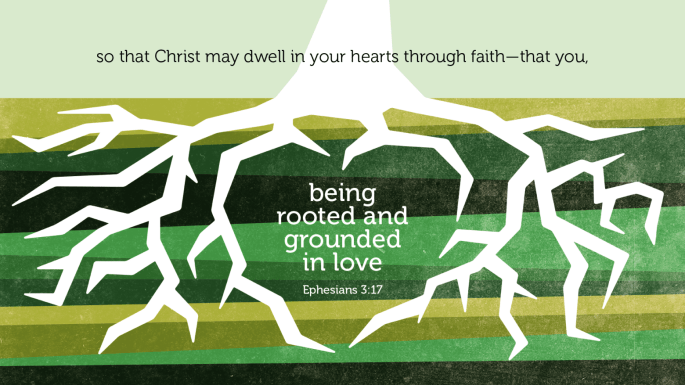
Being rooted in God’s unconditional love is more than a belief. Paul says in Ephesians,
So that Christ may dwell in your hearts through faith. And I pray that you, being rooted and established in love, 18 may have power, together with all the Lord’s holy people, to grasp how wide and long and high and deep is the love of Christ.
I preached a sermon on Jesus a few weeks ago, asking Peter if he loved him. Jesus asked in Greek, “Do you agape me?” Agape is altruistic, self-giving love, seeking nothing in return. Agape is desiring and acting for the good of another life. It may be related to the love of friendship or lovers’ passion, but the word describes a unique aspect of love. The closest phrase to agape in English may be “unconditional love.”
Psychologists began speaking about unconditional love in the mid-20th century. Carl Rogers revolutionized psychotherapy with the idea that demonstrating an unconditional positive regard for the client is a pre-condition for healing and growth. A social psychologist and philosopher, Erich Fromm, wrote “The Art of Loving” (1956), exploring unconditional love as a transformative force. He suggests unconditional love requires genuine care, respect, and understanding for the other person without expecting anything in return. Fromm emphasizes the dynamic nature of unconditional love, stating:
“Love is an activity, not a passive affect; it is a ‘standing in,’ not a ‘falling for.’ In the most general way, the active character of love can be described by stating that love is primarily giving, not receiving.” (Fromm, E. The Art of Loving, p. 6)
Therefore, unconditional love requires character development, self-awareness, and the ability to overcome our limitations. Embodying unconditional love is a lifelong process of personal growth. By starting our Mission Statement with “Being rooted in God’s unconditional love,” we commit to being a community that fills us with this capacity.
We need to talk about what unconditional love is not. Love does not give up our personal boundaries or force us into continued harmful situations. Love does not mean putting up with abuse. Just as you would not let a child run into a busy street because you respect their autonomy, nor do you want to enable any destructive behavior. You can respectfully tell someone no. It can be an act of love to say where we stand and what our boundaries are. Tough love is not incompatible with unconditional love. That idea probably deserves an entire sermon. Our goal here is to remember as we navigate these challenging situations, we are rooted in God’s unconditional love for us.
The strength to love, especially when people are frustrating, indifferent, or even hostile to love, takes more than what we can offer alone. We need the deep roots of God’s love to hold us firmly, nourish us and heal us to persevere. Christian mystics understood this long before psychology came along.
Meister Eckhart said, “If someone were to ask me what God is, I would say that God is a lover. And so, God has given all creatures a little seed of love, and this is all they need.” (Meister Eckhart, Sermon 16). This quote illustrates the fundamental nature of Christian spirituality. We love because God first loves us. God loves us before we can even care for ourselves when we might be baptized as infants. We don’t achieve love; we receive it from the Divine Spirit
We take in a lot through our minds in church, listening to scripture readings, sermons, and prayers. Faith is also formed in the heart and even in all five senses of the body. Through guided meditation, I want to invite you into a mind, body, and heart experience of being rooted in love. This meditation will characterize the three things that roots do for a tree. First, roots draw water and nutrients to nurture the tree’s life. Second, roots provide the strength and stability to stand in a storm. Third, like a tree producing oxygen as a gift back to the world, love helps us participate in the life cycle and God’s work in the world.
Imagine your favorite tree. Allow a picture of its shape and branches to become more apparent in your mind. Your tree may have broad leaves like maple or evergreen pine needles. It’s your tree, so it can have pink spring blossoms or fall fruit hanging from its branches. Let those feelings of wonder, comfort, and even love sink into your heart.
First, we will focus on the underground strength of your tree’s roots. Push both feet into the floor and be in touch with the ground. Spread your toes and imagine each one as a separate root pushing down into the earth, connecting you deeper below the surface. Hold your hands palms up in your lap. Spread your fingers as branches. Pause on each toe as a root and get in touch with your system below the surface. Sense the cool earth on your roots and the feeling of rich soil as you dig in with all your toe roots. Imagine as much of you being underground as above ground.
Roots bring energy and nutrients into the tree. Feel your roots drawing energy upward into your body. Imagine each root sipping from the earth like a small straw as the energy moves up your legs and torso and out to your arms. You can even raise your arms a bit as much as comfortable to feel them like limbs drawing energy upwards. If you are feeling energized your arms can go past your shoulders and over your head, or you can leave them a waist level. Take a moment and draw the energy of love up from the roots of your toes and all the way out to your arms and fingertips, like branches and leaves.
Roots also give a tree stability. Remember, half of you is underground. Sense how your roots are holding you in place. Imagine the wind picking up around you, and it blows you left to right, causing your torso trunk to rock gently. The wind blows a little harder and rocks you further over. As the wind increases, feel your trunk stabilizing you below. The wind is pushing hard enough to lean you over, but your roots have you. Even as your torso and arms sway, you are firm in your place. You are so deeply connected down into the ground that the earth holds you in love through any storm.
Now that you have nutrients from the soil and a taproot of stability, you are firmly rooted in love. You have love to give. You have taken in water and earth, and now you are sending out life-giving oxygen to the whole living world. Being rooted in love is a cycle of receiving and giving. Because of your roots, you have love to share. Send out your oxygen so everything can breathe and live more fully. Spend a moment receiving loving energy from your roots and sending it out around you. As you send love out, the people around you are doing the same thing. Take in this love with a deep breath, and return it with a long, slow exhale. Try a few cycles of giving and receiving love through these long breaths.
To draw to a close, hear Paul’s words from Ephesians again,
So that Christ may dwell in your hearts through faith. And I pray that you, being rooted and established in love, 18 may have power, together with all the Lord’s holy people, to grasp how wide and long and high and deep is the love of Christ.


 Todd Weir